Showing posts with label Random topics. Show all posts

Sunday, September 7, 2025

Phone astrophotography

 Phone cameras have come a long way and are inching closer to the capabilities of DSLR and mirrorless cameras when it comes to astrophotography. Improvements in sensor technology and built in post processing features such as HDR, stacking and star alignment being have made them into a useful backup or even a viable replacement for traditional cameras, especially when used with a tripod. These days, I find myself using my phone more than my DSLR for milky way photography.

The photos that follow are some of my favorite shots of the milky way and landscapes taken using an iPhone 14 pro, on tripod with the maximum 30s exposure in the built-in camera app, and later edited in Lightroom mobile. 

The above was taken at Lerderberg State Park Victoria aiming directly at the zenith around the end of winter. 


These two photos were taken in Point Lonsdale lighthouse. The red light from the lighthouse lit up the surrounding rock formations in red as seen in the top image. What is also interesting is that the second image would not have been possible on a single exposure on a DSLR, as the light from the lighthouse would have washed out the image. It appears that the phone has automatically stacked images of various exposures to create a composite image.


These images were taken at the Gravity Observatory in Perth. While a lot of stars are visible the image contains a lot of noise highlighted during the edits, possibly showing the limits of phone night photography.


The first two phots above were taken at Lake Tyrell, and third at the town of Sea Lake. In the second image, the moon illuminated the surroundings and overpowered the stars, but I was able to capture the reflections of a few stars on lake's calm surface. 


These two images are the latest ones taken at Aireys Inlet beach. The last one is my favorite so far since it highlights the details of the milky way as well as the rock formation. I used the flashlight from another phone to briefly light up the rocks while the image was being exposed for 30s, and in my opinion it resulted in perfect exposure of both landscape and the stars. 

While phone cameras have made impressive improvements and deliver impressive results, DSLR and mirrorless systems continue to advance in their own right. Still, smartphones offer unmatched accessibility and portability - and as the saying goes, "the best camera is the one you have with you".


Saturday, May 11, 2024

Southern lights in Victoria

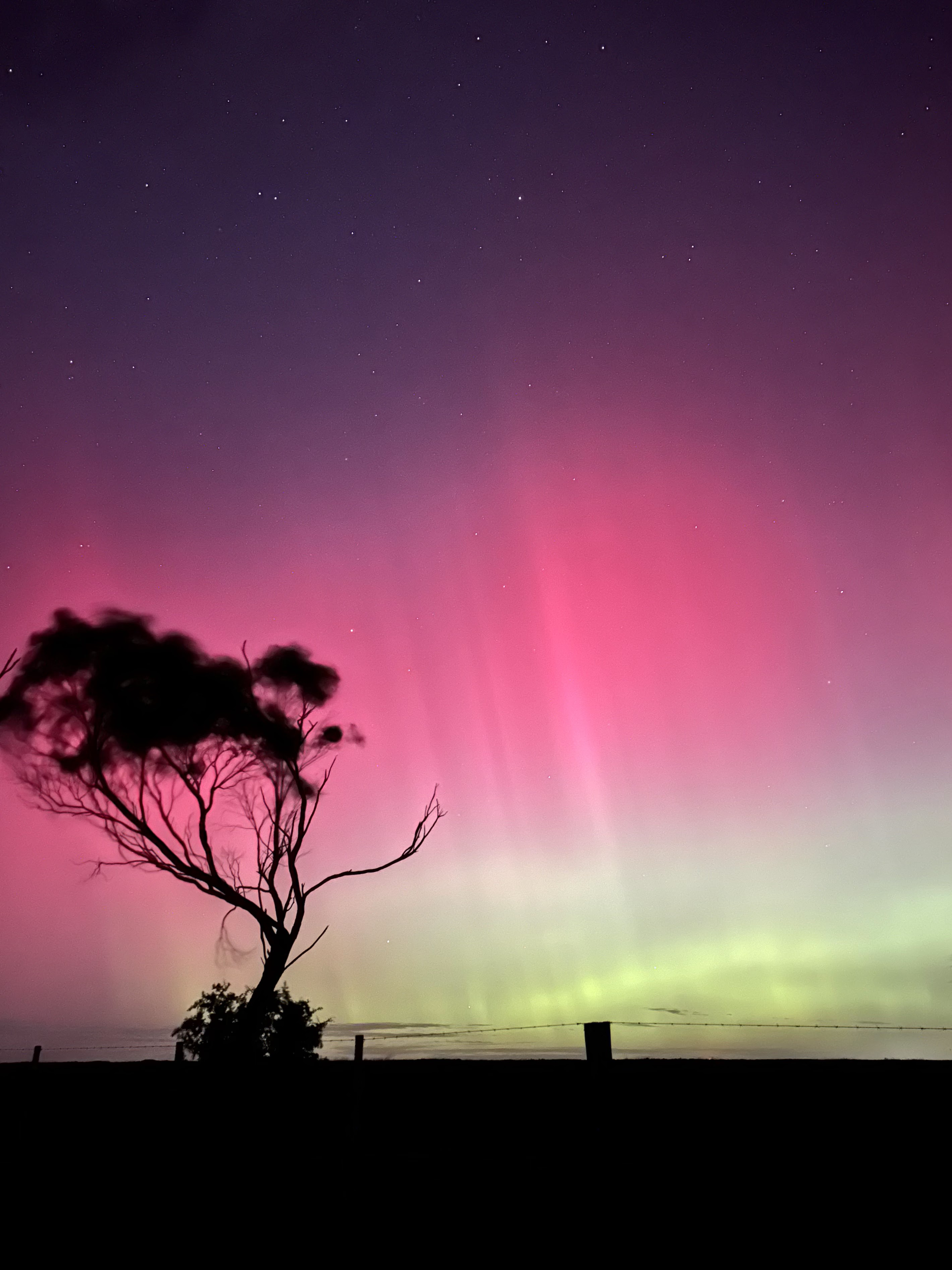
It's usually not easy to catch a glimpse of Aurora Australis, the southern lights, from Victoria. Tasmania and New Zealand are better places to be. The occasions when it is visible from in Victoria, it's best seen from the southern coasts of the state and usually appears as a faint glow to the naked eye. My last post on astrophotography had a picture of the southern lights taken from Flinders. But with the intense geomagnetic storm yesterday auroras were expected to be visible from many parts of the world. 

As soon as I got to know this I looked for the closest southernmost point, and being in the west of Melbourne, this was Kirk Point in Point Wilson. While driving there I was amazed to see the green and pink shifting columns of light to the naked eye while still on the highway, and stopped to snap a few pictures as soon as I took the exit. Afterwards we went to my intended location and was treated to the spectacular southern lights show. It waned off around 11pm but was still visible even from my backyard after reaching home around midnight. 

Some pictures are below:


Sunday, March 24, 2024

More blue water - why is the Nil Diya Pokuna blue?

On my last visit to Sri Lanka, I was keen on exploring some lesser-known attractions and decided to visit Nil Diya Pokuna (නිල් දිය පොකුණ) located close to Ella in the Uva Province. I was impressed and fascinated by the massive underground cave complex and the blue water pond at the end of the 850m hike through the cave. This was the second time I saw clear blue water in Sri Lanka, the first being in a limestone quarry.  

The usual reason for ponded water to appear bright blue or turquoise in colour is the fine particulates that selectively scatter light through water (the same reason why the sky is blue). In the case of the limestone quarry the fine particulates are minute calcite crystals and in the case of glacial lakes they are finely ground rock particles known as glacial flour. 

Nil Diya Pokuna has a very interesting geology, with several different rock types present around and within the caves, and I wanted to understand what gives the water its blue colour. Caves of this scale are usually formed by the action of weathering and erosion of sedimentary rocks such as limestone. However, this region of Sri Lanka consists of primary of metamorphic rocks. This blog post by Dr Jayasingha describes the geological origins of the cave complex containing Nil Diya Pokuna. According to it, the caves have been formed by the initial dissolution of Marble, which leads to weakening of rock joints and bedding planes and subsequent collapses of the other rock masses creating the large underground caverns. 

Marble is formed by the metamorphosis of limestone, and its dissolution would lead to the release of calcite crystals. There are stalactites formed at several places within the cave, as seen in the photos below, that confirm the occurrence of marble or limestone dissolution. Therefore, it is reasonable to conclude that the reason for the blue coloured water in Nil Diya Pokuna is the calcite crystals that are accumulated in the water as it flows through the joints and fissures in rock containing marble or limestone before making its way into the pond. Below are some photos from my visit:

Stalactites in the cave indicating marble or limestone dissolution
 
Evidence of weathering and staining in the rock

Visible bedding planes and smooth joint surface of a possible collapse leading to cave formation

Blue water and more stalactites

High water levels were blocking off some more expansive areas of the cave

The water was a little murky due to recent rains


Sunday, November 13, 2022

More pictures looking to the heavens

Back in 2017, I wrote a post on beginner astrophotography as I was just getting into the hobby. It was mostly a collection of my very first Milky Way pictures that I took at the time. Since then I have been taking more pictures of the Milky Way, and some occasional pictures of the moon, planets and the aurora. So here's an update of my latest selected pictures in the same format as last time, with details in the caption.

This picture was taken at Cape Schanck, one of my favorite places to capture the stars. It's a single exposure with light painting, so the staircase is out of focus. 

One of may favorite pictures taken under perfect conditions. Moon was out on the opposite side of the Milky Way to illuminate the landscape perfectly. Location: Flinders

This is the first picture in which I was able to capture the reflection of the stars in water. Location: Lake Eildon. 

The daytime moon captured through my telescope. I attached the camera into the eyepiece of the telescope with a lens adapter. 

Two photos of Jupiter and Saturn also taken from my telescope. I recorded a short video and processed it using PIPP and AutoStakkert to create these images. Haven't done planetary imaging since, but I do hope to try it out again sometime soon. 

A photo captured from my balcony one evening showing earthshine on the moon. 

The rising moon captured using a telephoto lens without a tripod. 

My first attempt at capturing star trails. This is a single exposure taken over approximately 12 minutes. Photo taken at Lake Eildon. 

This is my first attempt to capture the Aurora. The pink glow is the Aurora Australis seen from the Southern Coast of Flinders. 

This picture shows the recent lunar eclipse- the blood moon, as seen from Flinders shortly after sunset on 8 November 2022. 


Thursday, June 18, 2020

Another web app to estimate the soil water retention curve

I created another simple web application to estimate the soil water retention curve from basic particle size distribution data. I used the equations developed by Zapata et al. (2000). The water retention curve can be exported as before and the previous app can be used to estimate hydraulic conductivity and oxygen diffusion coefficient of the soil after fitting to the vanGenuchten model.

Link : https://rukshan-azoor-psd.anvil.app/

I have also embedded the app below:  


Saturday, June 13, 2020

Building a web app with nothing but (a bit of) Python

My knowledge of Python (the programming language) is not extensive. I have used it a few times to streamline some of my research activities that include data handling and processing. I find Python easy to get into without much programming experience and sources like Stack Overflow help very much to do this. So when I came across a web platform called Anvil that claims to let you build fully functional web apps with nothing but Python, I decided to give it a try. I was pleasantly surprised, and happy with the web application that I was able to build with a relatively basic knowledge of Python and nothing else. My code may not be the most efficient, but it gets the job done.

I decided to build an app within my area of research. It is an app to estimate soil hydraulic properties and oxygen diffusion coefficients at different degrees of saturation, based on water retention properties of the soil. I used equations from literature and those developed in my own research to do this. Two water retention curve parameters (van Genuchten α and n) and the soil porosity are used as inputs and the hydraulic conductivity function and oxygen diffusion coefficient characteristic are generated using the equations. I used the Plotly library built into Anvil to generate three plots for the generated functions and the water retention curve. I also built in an option to export the generated data as a text file that can be used for further analysis.

I was able to do this with the free plan that Anvil offers. Anvil also has a paid subscription plan that has more Python libraries and more options for development support and deployment. I believe it is a great product with exciting capabilities.

My first web app can be accessed at :  https://rukshan-azoor-wrc.anvil.app/


Sunday, August 26, 2018

More turquoise water

Back in 2014 I was fascinated by the bright turquoise water that emerged from a base excavation at the Aruwakkalu limestone mine in Sri Lanka. I was doing my undergraduate internship at the time and was so intrigued that I researched into the phenomenon and wrote a blog post explaining how the turquoise colour emerges due to selective scattering of light caused by calcium carbonate crystals. A picture that I took was also featured in the Mining magazine. Four years later I came across the striking turquoise water again.

I am currently a visiting research student at the University of British Columbia, Canada and recently visited some glacial lakes in British Columbia. I got to see once again, the bright turquoise colour that intrigued me 4 years ago. The reason behind the turquoise colour is the same selective scattering of light. This is caused however, not by calcium carbonate crystals but by glacial flour/rock flour, which is the name given to very fine rock particles generated by glacial erosion, and remain suspended in the water. The lakes I visited were the three Jofrre lakes and Garibaldi lake, where I even went for a relaxing swim. Some pictures that I took at the lakes are below.

Upper Joffre Lake

Middle Joffre Lake

Garibaldi Lake

Garibaldi Lake


Thursday, April 10, 2014

Jet Skiing at Unawatuna

Unawatuna is known for its pristine beaches and is one of the most popular tourist destinations in Sri Lanka. For thrill seekers going on holiday to Unawatuna, The Unawatuna Water Sports Club offers a wide range of water sports. On my recent visit to Unawatuna I tried Jet skiing. Having ridden a jet ski on a river before, this was a totally different experience. The waves and undulations of the sea makes it much more exciting.

Located in front of the Cormoran Beach Club, the friendly staff at Unawatuna Water Sports Club will guide first timers. A safety jacket is provided and an instructor will accompany you if needed. The Jet Skis at Unawatuna Water Sports Club are easy to operate as you only have to accelerate and steer. It only takes a while for you to master the controls and start skiing like a pro.

In addition to Jet Skiing, Unawatuna Water Sports Club also offers, Surfing, Sailing, Banana Boat Rides, Doughnut Rides and Kayaking.


Thursday, March 20, 2014

Turquoise Water in a Limestone Mine

Clear turquoise water is often associated with tropical beaches. An open cast mine is probably the last place one would expect to find clear blue or turquoise water. The pictures below were taken at the Aruwakkalu Limestone mine in Puttalam Sri Lanka.

When limestone is excavated from the base of the quarry, and when the excavated pit reaches the ground water table, water starts seeping in. It is this water that has a spectacular turquoise colour. The reason for this colour is not the blue reflection of the sky like in the case of seas and lakes. It is due to the scattering of light by minute Calcite crystals.

Limestone is essentially Calcium Carbonate and the water in the limestone pit contains a large amount of it dissolved. Once the water gets saturated by calcium carbonate, it starts to crystallize and forms very tiny crystals which remain dispersed in the water. This crystalline form of calcium carbonate, is known as Calcite. These micro Calcite crystals scatter light selectively giving it a turquoise colour.


Since Calcium Carbonate is alkaline, this water has a high pH value. Therefore, as inviting as it looks, taking a dip in this water is not advisable. Prolonged exposure to water with a high pH can cause skin and eye irritations.


Tuesday, February 25, 2014

The Intricacies of Mud Crack Formation

Patterns found in nature are most often astoundingly complex while also being elegant and aesthetically pleasing. Snowflakes for example consist of extremely delicate, symmetric structures of frozen ice and are always different from each other. Yet these infinite patterns are influenced by only two main controlling factors, temperature and humidity. A  more obvious example of patterns in nature are mud cracks. Although they are not as delicate and complex as snowflakes, they also exhibit some patterns that are interesting to observe. What follows are some facts I gathered from a small study about mud cracks and some  photographs taken during my training period at the Aruwakkalu limestone mine.


Mud cracks are formed quite obviously, when  mud dries up. So the main factor controlling mud crack formation is moisture content. Unlike in glass and many other materials, cracks in mud do not originate at single point and then propagate. If the rate of drying is uniform across a surface of a layer of mud, cracks will start appearing simultaneously across the surface. Mud starts to dry from the exposed surface. So when the moisture content of the surface layer starts to drop, the mud particles come close to each other as the space occupied by water is emptied. This results in the contraction of the surface layer. This causes stresses to build up on the surface layer and ultimately results in the formation of cracks. First the main cracks divide the exposed surface into a series of "islands" then, secondary cracks may occur within these islands.

primary and secondary cracks

Since drying starts from the surface, the bottom layers still contain some water and still remain expanded. Therefore the width of the crack is lesser in bottom layers, like a cut made from the surface. As the moisture content further reduces and the bottom layers also dry up, the crack propagates to the bottom layers and the gap widens. 

If the moisture content in a single layer of mud differs at the top of the layer and the bottom, the amount of contraction also differs. The top portion will contract more than the bottom portion. This will result in an upward curving of the layer like in a bimetallic strip. If the wet mud has been standing for a long period, stratification of different layers will take place. Stratified layers can be observed when a portion of the cracked mud is viewed sideways. Stratified layers can have a bigger difference in contraction rates, and if the layers are strongly adhered to each other, a more prominent curving of the layers will be seen.

stratification and upward curving of layers

If the layers are not strongly adhered, instead of curving upwards, the layers will separately contract producing a step like effect of the cracks. 

step like contraction

Although the mechanics of mud crack formation has no immediate practical application, crack formation in other substances is studied extensively. Crack formation on thin surface layers in electronic circuits can lead to peeling off of printed components and cause problems. Therefore a lot of effort is put into preventing the formation of such cracks. A very fine network of small cracks can be seen on the surface of old paintings on close inspection. This fine set of cracks is called "craquelure".  The characteristics of these cracks depend on the type of pigments, oil and also the ambient conditions at the time of painting. For this reason, these cracks are used to authenticate old paintings. 


Tuesday, July 30, 2013

eZ Cash - Behind the Veil

An interesting point came up in our last Marketing Management lecture-the true motive of Dialog eZ Cash. Whether it is merely a convenient mobile payment method or a tool to acquire information about customer behavior was discussed. In this information age, information about the spending patterns of customers is potentially worth millions to organizations. This type of information can be used for targeted advertising. It can bring massive profits to an organization by helping them to better understand  their customers and to cater specifically according to their requirements.


Although Dialog eZ cash is not extremely popular, it's certainly catching on. Despite some concerns about delays and problems in withdrawing cash from merchants, it is undoubtedly a convenient mobile payment method. While the newer payment methods via NFC are quicker and more straightforward, at present only a handful of smartphones used in Sri Lanka are equipped with NFC. In this regard eZ cash scores by being accessible to the masses. This also broadens their source of customer information. Such information is valuable only if it's extensive. Whenever a customer uses eZ cash, information about the transaction amount, place and type gets recorded at the company servers. Users of eZ cash agree to their information being used, stored, analyzed or transferred by Dialog without the consent of the user, when subscribing for the service.

users agree to their information being stored,analyzed and transferred. source: http://www.dialog.lk/content/uploads/pdfs/tc/ez-cash-tc-eng.pdf

Collecting customer information is not necessarily a bad thing. Most of us are familiar with the personalized search results and news feeds in Google and Facebook which  utilize search history, browsing patterns and location to serve personalized information. While some people argue that this is an invasion of privacy, it is often helpful to most of us. Personalized search results bring relevant information quickly. The data collected by eZ cash also could be put into good use like this, to serve customers better and to personalize the telecommunication giant's service.

The flip side to this story is the consequences if this data falls into the wrong hands. It can be used for spamming or in the worst case, for fraud and theft. A security breach or something similar could turn out to be a threat to customers. Dialog would surely be aware of this and have taken necessary measures to avoid such a situation. Still, some people don't feel comfortable about their information being used in this way. But complete anonymity in today's world is impossible to achieve. The best is to be aware and mindful of how your information is used and shared by the services that you use.


Tuesday, April 30, 2013

The Future of Wireless Charging

While Android and IOS dominate the operating systems in today's smartphones, Nokia stays in the game with its innovative hardware. The inclusion of wireless charging in the recently released Lumia 920 made wireless charging a hot topic. Although wireless charging may sound like a modern breakthrough in technology, it is a pretty old concept. For starters, we tend not to realize that our radio sets are actually receiving energy wirelessly. The purpose of external power in radios is to amplify the signal and to play it back with clarity. The simplest radios-crystal radios operate without any external power.

Wireless charging by inductive coupling has been used in Oral-B toothbrushes since the early 1990s. But wireless charging was not common in consumer electronics such as mobile phones and laptop computers due to constraints in efficiency and rate of power transfer.  However with new improved technologies and standards such as "Qi" and Qualcomms's WiPower, wireless charging has started to make its way into modern smartphones and tablets. Intel's upcoming ultrabooks will come with the ability to charge smartphones that are placed beside them.

source : qualcomm

Wireless charging of consumer electronics is primarily classified into two categories.
1. Inductive Coupling.
2. Resonance Charging.

Inductive coupling uses the theory of electromagnetic induction to transfer power from one source to another without physical contact - like the power transfer from the primary winding to the secondary winding in a transformer. Because the strength of a magnetic field diminishes rapidly with distance, inductive coupling requires the charging source and the device to be very close or in contact with each other.

Resonance charging improves the above concept by using electromagnetic resonance. The coils are made to resonate at the same frequency and this enables power transmission through a greater distance. This means that the device only needs to be in the vicinity of the power source. This method has been found to be effective over distances of several feet.

source : intel

So what will the future of Wireless charging look like? Current areas under research provide clues about it. Major computer manufactures are already in the process of introducing remotely powered phones, laptops and tablets. The idea would be eventually to make charging as simple connecting to a WiFi network. Wireless power transfer using Resonance Charging has already proved successful in charging several devices in a room simultaneously. In the future coffee shops and other public areas will be equipped with the facility of wireless charging and our smartphones and computers will power themselves automatically using these "charging hotspots".

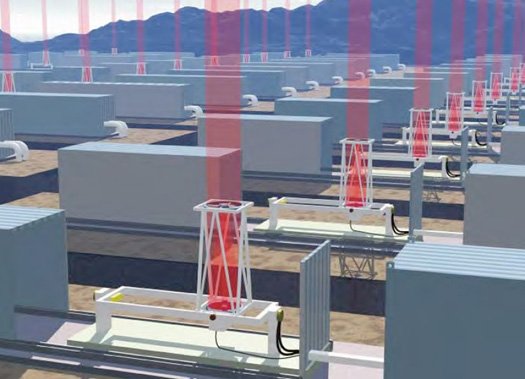
Moving on to a larger scale in wireless power transfer, a prototype aircraft called SHARP which flies using energy transmitted from the ground has been developed. Laser propelled spacecraft is another field under research. The company Lightcraft Technologies aims at developing spacecraft which will be powered by laser beams directed from the earth. The idea is to use the laser beam to rapidly heat and expand air which in turn will propel the spacecraft. This eliminates the need to carry fuel, which is the heaviest component in a space craft.

source : popular science

Using microwaves to beam power from solar power stations in space to the earth is another idea that is under consideration. Beaming power to earth from space has some environmental benefits but it poses a lot of challenges. Safety also would be a major concern in such an arrangement. Starting from handheld devices, wireless power transfer will one day be used in all our energy needs and will give rise to a truly wireless future.