Wednesday, April 11, 2012

Tsunami - to hit or not to hit..

I must admit that I did not notice the tremors that hit Colombo in the afternoon although most people had. I was at McDonalds having my lunch at the time, and when I stepped out I saw so many people gathered on the Galle road with their cellphones held to their ears. I was wondering about this strange behaviour when my mother called and told me about the earthquake and a possibility of a tsunami and asked me to come to her office at once. At this moment I just had a hunch that a tsunami was not going to hit although I had no information at that time whatsoever to come to such a conclusion.
The main shock had a Richter scale magnitude of 8.6 and caused widespread panic and also brought about the release of tsunami warnings in several countries including Sri Lanka. Having had an  extremely bad experience with the 2004 indian ocean tsunami these actions were appropriate. However even after the estimated arrival times had been issued, no tsunami arrived.
Earthquakes are not rare. Hundreds of earthquakes occur throughout the globe at any given time. Most of them are too small to even notice. The rare ones with the large magnitudes are the ones that cause trouble. The following diagram shows the data from USGS of some recorded earthquakes. In order to minimize the number of earthquakes displayed, only the details of earthquakes that are greater than 5.4 in magnitude in the region depicted in the map are given. (click on image to enlarge)

source - USGS -  http://earthquake.usgs.gov/earthquakes/map/

Note that in total 6985 earthquakes have been recorded in the past 30 days. The one that is highlighted is the 8.6 main shock that raised concerns of a tsunami. The rest are aftershocks. Clearly this earthquake took place very close to the epicenter of the 2004 one and therefore was expected to replicate the same effects, but it did not.

While Tsunamis can be generated by various methods such as earthquakes, landslides and even meteor strikes earthquake generated tsunamis are the most common, although the largest recorded tsunami was caused by a landslide at Lituya bay, Alaska (source : http://geology.com/records/biggest-tsunami.shtml). It must be noted however that not all earthquakes can cause a tsunami. Several conditions need to be fulfilled for the generation of a tsunami wave. They are as follows
1.  The earthquake should have a large magnitude ( greater than 7.0)
2.  The earthquake should be a shallow focus earthquake (focal depth less than 70km)
3.  The epicenter of the earthquake must be at an active plate margin near or in the ocean.
4.  There should be a vertical displacement of the plate (a thrust fault).
5.  The displacement should occur over a considerable area to displace a large volume of water.
Although not a hard and fast rule, these conditions need to be satisfied for a tsunami. The earthquake that hit today(11.04.2012) did not fulfill all these conditions.
Given below are the details of today's earthquake.

source - USGS -  http://earthquake.usgs.gov/earthquakes/recenteqsww/Quakes/usc000905e.php 

While the earthquake had a large enough magnitude and a shallow focus, the earthquake occurred as a result of strike slip faulting and not thrust faulting (source : http://earthquake.usgs.gov/earthquakes/eventpage/usc000905e#summary) . Therefore there has not been a considerable vertical motion of the plates in order to displace a large volume of water. This was the reason why a devastating tsunami was not generated.
While we were lucky today and the warnings and preparation were seemingly unnecessary, we can now be assured that proper warnings will be given and that we are prepared to take necessary measures in the case of an actual threat.


Tuesday, April 10, 2012

Sand Mining and Storm Damage

Beach sand mining has increased during the past few decades as river sand has gradually depleted causing several environmental problems. Beach/sea sand is not suitable for construction purpose as a replacement for river sand due to its salinity. The salinity in the sea sand can corrode steel reinforcements and cause structural failures if used in concrete. However the sea sand can be thoroughly washed to remove its salinity before using it for construction purposes. Due to this reason beach sand is mined increasingly in order to avert the environmental damage caused by mining river sand.
This is not a good solution because beach sand mining has its own harmful side effects. While most will agree that offshore mining is not very environmental friendly few realize that beach sand mining is as catastrophic. The sand on the beach and in the sea belong to one dynamic system. Removing sand from the beach therefore will disturb this balance.


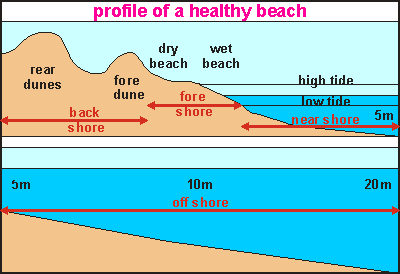
image from http://www.seafriends.org.nz/oceano/beach.htm


This is what a typical healthy beach looks like. Even the sand far away from the water are part of the beach. The dunes on a beach serve a purpose.

image from http://www.seafriends.org.nz/oceano/beach.htm


The above picture depicts the behaviour of the sand during a storm. Note how sand is borrowed from the fore dunes to create a bank below the sea level. This bank helps to break the waves and dissipate energy thus minimizing the damage caused by the storm.
So what would happen if the sand is carelessly removed from the beach? There wouldn't be a way for the beach to adapt during a storm. This will lead to severe inundation and damage.
The sand in a healthy beach undergoes a cycle known as the "beach cycle". The beach continuously adapts by moving sand and sediments and rebuilds itself after storm damage by itself. Removing sand from the beach could disturb this cycle and cause long term effects such as severe coastal erosion. This makes it necessary to explore alternative methods to mine sand. Deep sea sand mining, carried out far away from the coast could be a possible solution although its effects and impacts should be thoroughly assessed first.

Saturday, April 7, 2012

Ballooning in Sri Lanka

Recently I got an opportunity to fly in a hot air balloon over Dambulla. Having traveled only in mechanized aircraft such as aeroplanes and helicopters before, this was a different and an interesting experience for me. Hot air balloons are one of the simplest modes of flight and it is because of this simplicity that it is such  a unique and wonderful experience.
The method it works cannot be simpler, The air in the balloon is heated using a gas burner, Hot air is less denser than the surrounding air, so it creates lift. You can only control the force of lift in a hot air balloon, that is by varying the heat given to the air. Where you go is out of your control. It depends on the direction the wind blows. This is why hot air ballooning is considered a sport rather than a mode of transport.
Balloon flights are usually scheduled early in the morning because the air is still and calm at that time. During later hours of the day the increasing temperatures give rise to thermals-columns of rising air that can interfere with the balloon and make maneuvering difficult. (Interestingly, thermals that hinder a balloon flight are the essential ingredient in gliding(which I'm awaiting to try out) where the force required to stay airborne is provided by thermals.) Therefore the morning is the best time for ballooning, besides  the sunrise seen from a balloon is a sight to behold..
Once airborne the balloon drifts away until you decide to land. Landing is done by allowing the heated air to escape by opening a vent at the top of the balloon by means of ropes and cables. Just like any other air sport, a smooth landing demands skill and practice.

heating the air to inflate

straightening the balloon

just before takeoff

sunrise

the gas burner

shadow of the balloon

opening the vent to land


Tuesday, April 3, 2012

Fruits? No thanks..

Most people stare at me in  disbelief when I tell them that I don't eat fruits. Although I cannot give a reason as to why I hate fruits, and knowing that fruits are one of the main source of vitamins and minerals, I'm not that worried by it because I eat my vegetables.. Well most of it. There was a time when used to take small servings of apples and pineapples. These were the only fruits of which the smell did not make me want to vomit. But now I don't eat even these fruits. However I do enjoy fresh mandarin and orange juice, and an occasional packeted mango juice of a particular brand. That's it. That's the closest I ever come to eating fruits. I know that not eating fruits but drinking some fruit juices sounds weird and illogical. But it is an aspect of myself that even though I don't fully understand, defines me in a unique way.

looks pretty but no thanks..

Tuesday, March 27, 2012

Saruketha - A Sri Lankan Experience

Located in Kurunegala is a uniquely Sri Lankan restaurant named "Saruketha". Staying true to its name it has a refreshing, Sri Lankan village type atmosphere. A lot of attention has been given in creating that place, from the thatched roofs to the ambient music being played through perforated clay pots..They have a menu with a wide selection that is not restricted to Sri Lankan cuisine. The food is not exceptional although its unique surroundings and atmosphere makes it a worthy visit. However, the thing that grabbed my attention most is this funny weather forecast sign displayed at the entrance..

Weather Forecast

Monday, March 5, 2012

Using Bacteria to generate Electricity

It may sound like science fiction, but its actually a possibility that is under extensive research at the moment. The bacterium named "Shewanella" has the unique ability to reduce metals and some other compounds. This reduction process requires electrons to be supplied to the material that undergoes reduction. In order to achieve this, The Shewanella bacterium produces electrons and transfers them beyond its cell membrane to the material by secreting certain proteins. Since a flow of electrons is essentially an electric current, this means that this bacterium is capable of producing electricity, in theory at least. Currently research is being conducted to find ways to exploit this unique ability of the Shewanella bacterium to produce a stable source of electricity. If properly developed this can lead to a very effective and environmentally friendly alternate energy source and could give rise to other technologies such as fuel cells of biological origin.

Shewanella  (image from wikipedia)

Sunday, February 26, 2012

Earth's Structure

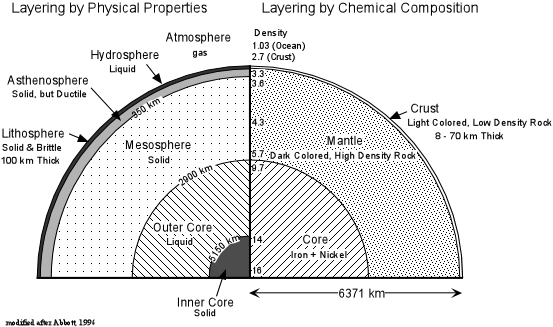
In a previous post of mine named Onion Earth I explained how the earth has a layered structure somewhat resembling an onion. The earth has several layers such as crust, mantle core, asthenosphere, mesosphere etc. Some of these layers overlap each other and thus can create confusion. This problem could be avoided by classifying these layers in two ways, one based on the Chemical composition and the other based on the physical properties.

Based on Chemical composition, three layers are identified.
1. Crust  -  Abundant in elements Si , O, Al, Mg, and Fe
2. Mantle  -  Mainly Fe, Mg, Si
3. Core  -  Ni and Fe alloy

Based on the physical properties five layers are identified.
1. Lithosphere  -  Rigid outer shell. Comprises of the crust and uppermost mantle
2. Asthenoshpere  -  Shows plastic behavior. Lithosphere "floats" on this layer. 5% of rocks in this layer is molten
3. Mesosphere  -  Extends from about 300km to 2000km beneath the surface. Solid
4. Outer Core  -  Molten. Rotates around the inner core and produces the earths magnetic field
5. Inner Core  -  Extreme pressure causes it to stay solid despite the high temperatures

Source : http://www.tulane.edu/~sanelson/images/earthint.gif